


The context
March 2020. COVID-19 hits the Netherlands. ICUs are at risk of overflowing and a shortage of ventilators becomes a real scenario. At TU Delft, an initiative emerges: Technical Medicine students and engineers from the Faculty of Mechanical Engineering start a project to develop an emergency ventilator in record time. The project is called Operation Air.
Ingmar and Sjors from Jitter join the team on campus. The assignment: design the complete control electronics and embedded software for a ventilator suitable for ICU patients. The timeline: weeks, not months.

Team photo with social distancing
Three weeks
From first sketch to production-ready electronics. Each week brought new challenges and breakthroughs.
Week 1: From idea to first PCB
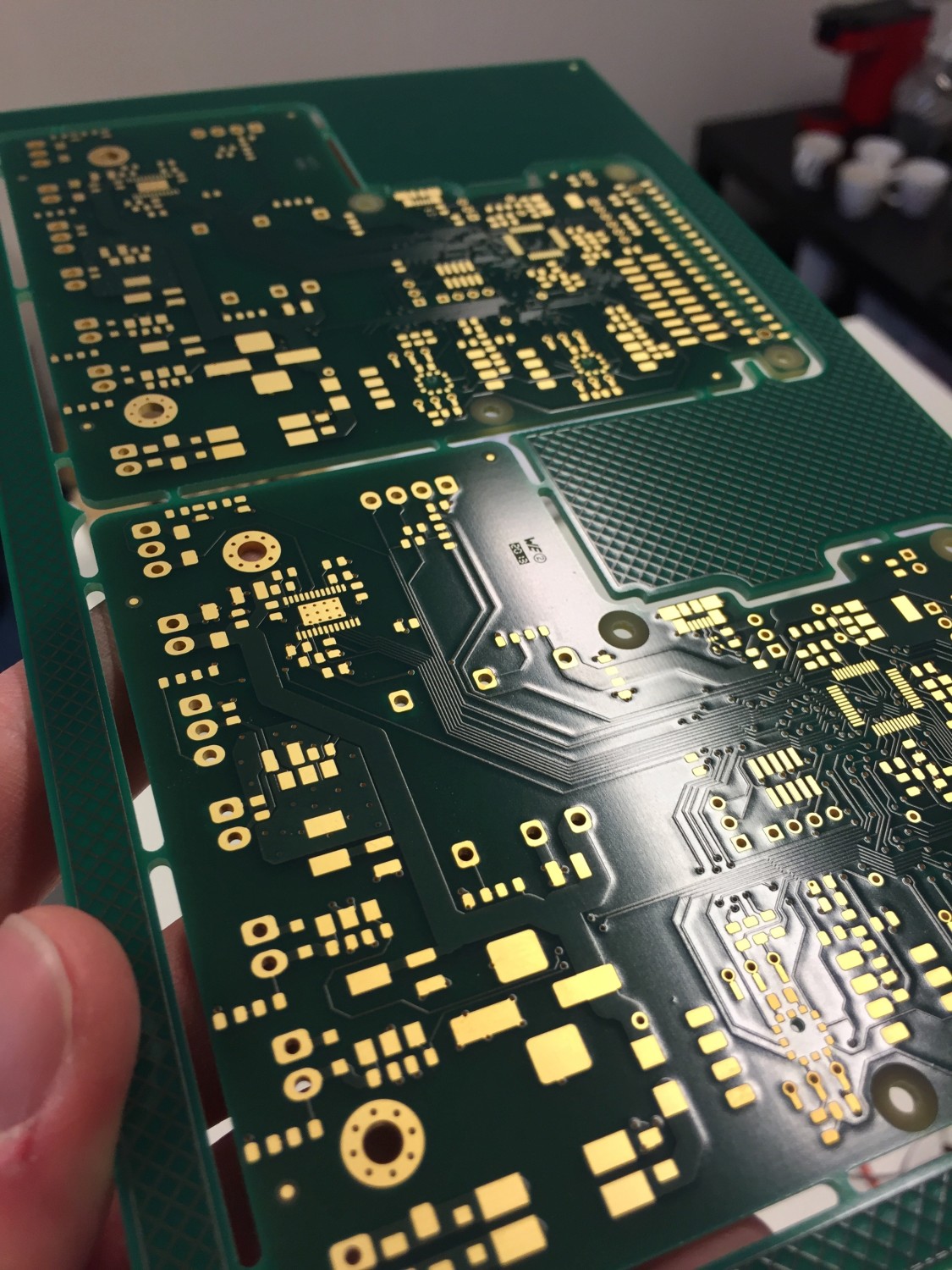
The first week was a pure design sprint. One day for inventory: what do we need, which components are available? One day for schematic design. One day for PCB layout. The bottleneck wasn't the design, but manufacturing: who can produce and assemble circuit boards on this timeline?
After a broadcast on Nieuwsuur (Dutch national news) about the project, companies across the Netherlands offered help. Wessel Koning from Interay Solutions in Friesland reached out and delivered four fully assembled PCBs by the end of the week. From schematic to hardware in five days.
Week 2: First prototypes running

On Saturday, the first circuit boards were assembled and tested at our office in Delft. The first prototype worked. In parallel, other teams worked on the housing, power supply, 3D-printed parts, tubing, control algorithms and preparation for clinical testing. The project was attracting national attention: both Minister Wiebes and Prime Minister Rutte visited.
Week 3: Production-ready
Changing requirements called for a second version of the electronics, now optimised for series production. This version went straight to manufacturing without an intermediate prototype. That sounds risky, but the experience from the first iteration provided enough confidence. By the end of week three, the AIROne was ready for clinical testing.
Embedded touchscreen

Besides the control electronics, Jitter developed the embedded touchscreen interface. The screen displays real-time ventilation waveforms, pressure and flow values, and alarms. Doctors and nurses in the ICU need to see the status at a glance and adjust parameters instantly. An interface where there is no room for confusion.
The result
Fortunately, COVID ICU admissions declined and emergency deployment of the AIROne was not needed. But the Dutch Ministry of Health commissioned the production of 80 units as an emergency stockpile for future crises. International interest emerged from other countries as well.
The project demonstrated what a small, focused team can achieve under extreme time pressure. In three weeks, from an empty desk to a production-ready medical device, with electronics that worked on the first iteration.
"Sjors and Ingmar, what great collaboration we had in OperationAIR. Your electronics knowledge was crucial to the team's performance in building a fully working prototype of the AIRone in 3 weeks, specifically designed for ventilating critically ill COVID patients in the ICU. Thank you so much for Jitter's commitment with such professionalism and dedication."

What Jitter delivered
- Schematic design — complete control electronics for the AIROne ventilator
- PCB design — from schematic to production-ready layout in days, not weeks
- Second revision for mass production — production-optimised redesign within the project
- Embedded GUI — touchscreen interface for real-time monitoring and control by clinicians
- Rapid prototyping — from first PCB design to working electronics in less than a week
- Crisis response — engineers deployed full-time with the team on the TU Delft campus
More about the project: www.operationair.org